AI is on everyone's agenda.
Few create real impact.
The advantage comes when AI becomes part of how the business runs every day. Many have started. Few have chosen the right use cases, aligned business and tech, and embedded adoption in operations.
Your customers are moving.
Your competitors are moving faster.
The question is not whether, but when you create impact.
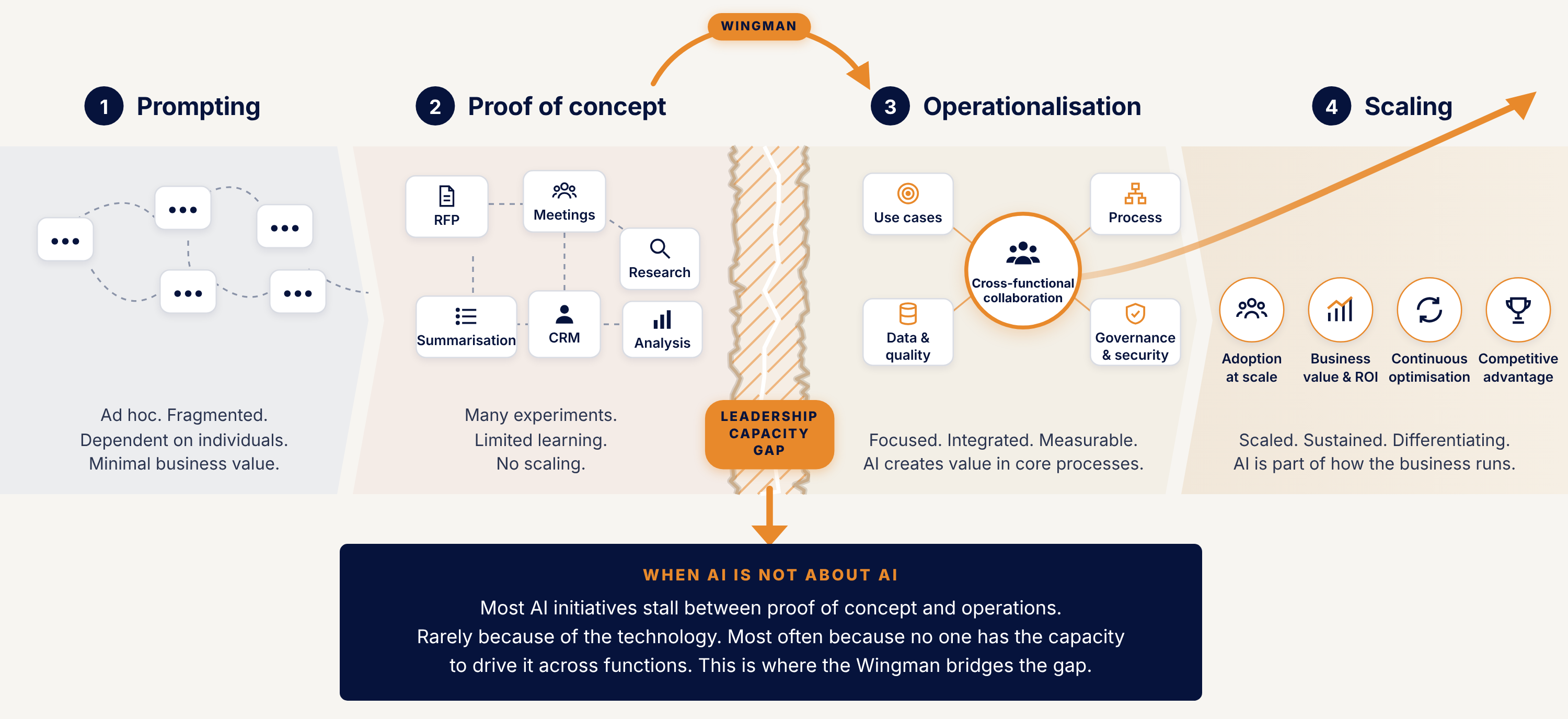
Prompting
Ad hoc, fragmented and dependent on individuals. Minimal business value.
Proof of concept
Many experiments. Limited learning. No scaling.
Operationalisation
Where the Wingman steps inFocused, integrated and measurable. AI creates value in core processes.
Scaling
Scaled, sustained and differentiating. AI is part of how the business runs.
Most AI initiatives stall between proof of concept and operations. Rarely because of the technology. Most often because no one has the capacity to drive it across functions. This is where the Wingman bridges the gap.
AI impact is a leadership issue
The technology is rarely the bottleneck.
Value appears when leadership connects business, tech and people and keeps momentum until new ways of working are embedded.
See where AI can transform entire workflows.
Prioritise where business value and adoption are greatest.
Connect business, tech and people, and keep the momentum.
Where AI initiatives often stall
From proof of concept to operational scale
Many pilots prove that AI works. Few become part of core processes. Moving from experiments to operations requires prioritised use cases, redesigned processes, data, governance and adoption across functions, on top of running the business. The Wingman leads the business side of that journey.
From efficiency gains to realised value
AI can free up hours across sales, service and operations. But freed capacity only becomes value when leadership decides where it goes, whether that is more customer time, faster growth or lower cost, and adjusts targets, roles and routines accordingly. The Wingman drives those decisions into operations.
A business-side Wingman for AI execution
Helping leadership move from experiments to operational impact.